The final season of "Better Call Saul" has drawn to a poignant conclusion, transcending mere companion status to "Breaking Bad" in terms of its moral, ethical, and regal depth. Their shared universe thrives on the ordinary lives of thoughtful individuals grappling with slightly extraordinary challenges. The human connection remains the most captivating aspect of each narrative, underscored by an unwavering belief that every moment in their lives is a product of their choices, leading them to the next.
The finale of Season 6 lacks the flashy grandeur of "Breaking Bad's" climax. Recall my earlier mention in Episode 10 that Jimmy's fate was sealed that day? Well, this rebirth is more sincere, honest, and ambiguous.
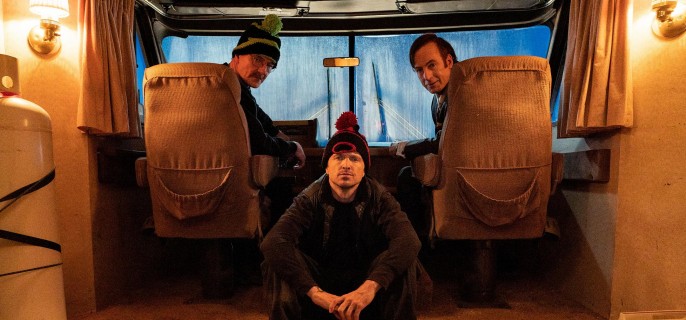
We begin Episode 13 of Season 6 with never-before-seen footage from "Bagman," Season 5, Episode 8. Mike and Jimmy have just escaped the death trap with $7 million, battered by the desert heat, and finally reach an isolated well. As they rest and rejuvenate, Jimmy suggests they flee with the money. Mike counterpoints that it's not theirs to take, prompting Jimmy to embark on a "thinking experiment": what would Mike do if he did indeed take off? Unfazed, Mike suggests they take $6 million and build a time machine. When asked what he would change in his life, Mike responds with December 1, 2008, but swiftly corrects himself to March 17, 1984—the day he could have prevented his first bribe and then periodically check in on his family. Jimmy, on the other hand, dreams of investing the remaining sum into Berkshire Hathaway on the day Warren Buffet took over, a move that would have turned him into a billionaire by today's standards. But this isn't an honest answer; Jimmy is holding back. Mike, unrelenting in his directness, asks once and moves on. The episode teases more of this dynamic to come. Can there truly be anything Jimmy wouldn't change? Regrets and choices are a recurring theme in the finale, a nostalgic turning of the clock for our most cherished characters in the shared universe.
We shift to the present as Gene goes on the run. Marion stands at the window, reading out the make, color, and number plate of Gene's car. Gene escapes through the back when he sees officers arriving at his house. The chase leads him to a dumpster, where his intentions with his belongings are unclear. My best guess is that he wants to reach out to Ed Galbraith, the Disappearer—a character who ran a vacuum cleaning store and whose business card Gene had taken. His fidgeting attracts the attention of officers, and he is caught. Gene is arrested.
As Gene waits anxiously for his phone call, the officers play a video of him as Saul, his professional demeanor intact even in this moment of uncertainty. He dials his workplace in the mall, inquiring after its well-being and apologizing for his absence, asking Kritsa to contact the management on his behalf—a new manager is needed. Saul can't help but feel a sense of disbelief. Is this the pathetic conclusion to his "heroic" tales and war stories? Frustration boils over as he hits the metal door, wincing in pain as he catches sight of a message on the wall: "My lawyer will ream your ass." Something sparks within him, and he demands another call. He reaches out to Bill Oakley, his old nemesis from the DA's side in the courthouse. And with this call, we bid farewell to Gene, as Saul emerges within.
In a most peculiar way, Saul makes a proposition to him. "Think what representing me would do to your career?" he says, referring to the media attention his private law firm will receive for being involved in this case. This is undoubtedly going to make headlines. Saul still has a trick up his sleeve, but he's not ready to accept defeat and give up. With his fake mustache off and his air brought forward, we see a familiar sight. He is brought in front of a panel of government lawyers, walking past Marie Schrader, who makes a surprise guest appearance on the show. The panel delivers a resounding sentence with vehemence: there is no way he is seeing daylight again in his life.
The scheming conman still has the one-upmanship spirit stirring him forward. He asks for Marie to be called in, and she delivers her piece without holding back her scything ridicule of Saul. The unimaginable loss to Hank, Gomez, and countless others is unforgivable. But in the most compassionate of tones, he begins weaving his preferential truth. He worked under duress and the threat of Heisenberg. He didn't relish doing what he did; he himself was a victim. While everyone is pointing a finger at him, he lost everything too; his profession, family, and his freedom. The AUSA mocks his efforts to come across as a victim, but Saul says he doesn't need the jury to buy his sob story; he only needs one of them. In the absence of a unanimous decision, the AUSA will lose the case, blotting his impeccable record.
The man is taken aback by Saul's crafty and morally corrupt legal genius. He actually convinces the AUSA to come to the negotiation room to explore "the wiggle room." From a hundred and ninety years (his original sentence) to seven and a half years; Saul is back. He starts getting cocky and even asks to be relocated to an amicable prison in North Carolina. He can't take the place he's in for granted and be sent to a place like ADX Montrose. The AUSA reluctantly agrees but signals they're done. But Saul has one more trick up his sleeve—he offers to give them one more unsolved mystery: that of Howard Hamlin. The panel laughs it off and reveals to him Kim's confession. Saul is shocked beyond words.
As we journey on to the 15th episode of season 5 in Breaking Bad, we find ourselves with Walter and Saul congregating under the tutelage of Ed the Disappearer, as they hatch plans for a new life. Walter indulges in his scientific mind, attempting to silence the click in the basin. As he does so, Saul poses a question, the same one he had asked Mike earlier. Walter dismisses the notion of a time machine with a laugh, saying it's not even theoretically possible. Saul reframes it as a "thinking experiment," and Walter is immediately hooked. He cries out, "Just ask about regrets!" before sitting down to contemplate one.
Walter then divulges the story of Gray Matter, the billion-dollar company he orchestrated out of existence. When Saul suggests he should have told him about this earlier, Walter dishes out his ultimate insult: "You're the last lawyer I would have gone to." One can only imagine what Chuck would think about that and how he'd hide his chuckles.
As Saul is being transferred to North Carolina, escorted by a Marshall on a plane with Bill, he takes a moment to plead with Bill to stop by the bathroom. He tries to coax the Marshall into believing that he can extract some incriminating testimony from Saul to report to the DA. What a cunning plan!
Bill reveals that Kim has taken a notarized statement to Cheryl, who is now lawyer-shopping to take her to a civil suit and take everything Kim has. Saul is concerned and, on Bill's return, he discloses that he has more information he'd like to barter with the government, even if it meant Kim falling deeper into the quagmire. Is this really what Saul will do? It's unlikely. But another scheme is already in the works.
That day at the office, Kim takes an early leave and heads to a nearby Free Legal Aid clinic to volunteer. The same night, Suzanne Ericsen, the DA from Albuquerque, calls her, informing her of Saul's arrest and the potential trouble it could bring her way.

