One of the most compelling aspects of "For All Mankind" as a continuous narrative experience lies in its seamless blend of the stark realism of historically accurate depictions of early space travel with the equally compelling reality that, given this is an alternate history that diverges significantly from established historical events, anything is indeed possible. In essence, while the episode concludes with a sense of resolution, there were fleeting moments where I genuinely feared for Molly Cobb's safety on the moon.
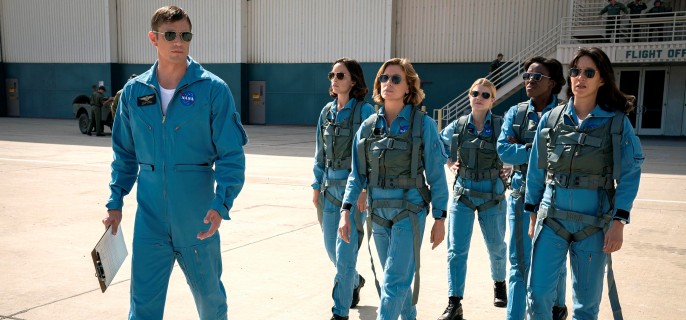
This sense of impending danger forms the crux of "Into the Abyss," an episode that, for the majority of its runtime, remains relatively calm and discursive, acknowledging that space exploration necessitates immense patience in the absence of warp drive. This applies to both the astronauts confined within their cramped lunar modules and their loved ones back on Earth, grappling with the tangible possibility that a myriad of things could go awry during this expedition.
This is why NASA overprepares for every conceivable scenario – and why it's a significant setback when, four days into the Apollo 15 mission, mission control realizes that there's no chance of finding ice at the crew's originally planned landing site. The crew is presented with two options: proceed with the mission as planned, despite its futility, or alter course and land at the Shackleton Crater, where there's a genuine chance of discovering something new.
Nixon's representative in the room holds a firm stance: Nixon desires to be the first to establish a moon base, and if America has to wait for the next mission to confirm a potential site for said base, the Russians will likely outpace us. (The CIA expresses concern that the Russians might deploy weapons on the moon. No one discusses whether America has similar intentions.) While mission control acknowledges that altering course is feasible, it's clearly a substantial risk, so it's left to the crew to make the decision.
Molly, perhaps even surprising herself, hesitates to alter the plan, partly due to her heightened awareness of public perception if this mission fails – a notion that it's because a woman was involved. However, Ed and Sedgewick manage to persuade her, and the change is implemented.
Following those tense opening minutes, the middle portion of "Into the Abyss" suffers from unfortunate monotony. Back on Earth, Karen continues to host NASA gatherings to watch daily updates, but her efforts to put on a brave face are hindered by Molly's husband, Wayne, who (as a pot-smoking psychedelic poster artist for bands like Santana) proves adept at expressing his emotions and fears. When he attempts to open up to her about his terror, she shuts him down, irritated that he's trying to discuss topics they "don't talk about."
Later, she bursts into his apartment, confronting him about his marijuana use (which, given that it's 1971, is illegal enough for Wayne to jeopardize Molly's career). However, what Karen really seems to want to do after all is talk, because as he said earlier, each understands what the other person is going through. It's rarely interesting when people talk about their dreams, but Shantel VanSanten acts the hell out of the scene in which she describes how her terror over losing Ed manifests itself in her recurring nightmare - a panther eating Ed alive in a clearing. Later, Wayne paints it for her, just like he painted his own nightmare about losing Molly "to get it out of his head." She accepts the gift but doesn't exactly rush to put it on the wall.
Also, astronaut Danielle is thrilled to welcome her husband, Clayton, home from Vietnam - especially because she's got some big news: While at the moment she's mostly appearing as "the token black girl" at public events, there is "one other thing they want me to do - fly to the moon!" She's been assigned to the Apollo 18 crew, with Gordo as her commanding officer, so the day after Clayton gets back, they meet up with Gordo at the Outpost to bond a little bit. What begins with Gordo guzzling Champagne devolves into all three of them doing shots of the brown and a heated conversation between Clayton and Gordo over their very different kinds of service: Thanks to NASA, Gordo got out of Vietnam, while Clayton was very much "in the shit." Between the alcohol, Clayton's anger at the war (he's wearing his uniform a day later but has already tossed away its ribbons), and Gordo being Gordo, there's nearly a full-on bar fight that hopefully doesn't jeopardize Danielle's future.
But there's no real follow-up on this story line yet because instead it's back to the moon. After yet another heart-to-heart talk, this time between Molly and Ed about how they're only where they are today because they were selfish enough to abandon their families and take this risk, it's their last day to find ice at the rim of the Shackleton Crater. There's nothing on the surface, so instead they come up with a dangerous cherry to put on this already pretty dangerous sundae: lowering Molly into the actual crater via a roll of cable and an improvised winch. Adding to the lack of safety is their rapidly depleting oxygen supply, which is why, yes, I was genuinely concerned for a few minutes that Molly might sacrifice her life in the quest for ice - the potential key to unlocking the entire universe for the space program. But, dozens of meters deep into the crater, in pitch blackness save a flashlight, she's able to find a very promising deposit, and then she and Ed (just barely, it seems) make it back safely to the LEM and return home.
And then we jump forward to October 12, 1973, and the landing of the Jamestown habitation module, the lunar base soon to be inhabited by "the boys of Apollo 21." That is ... a pretty big leap time-wise! Did Danielle still fly on Apollo 18? Is Nixon still president? Did Karen ever crack open that bottle of mescal that Wayne brought over? All very important questions, but for now, congrats, America. You finally came in first.

