Well, to "For All Mankind's" credit, it didn't shy away from the harsh realities of "Rupture." One of the lingering questions throughout the season has been, "What exactly is the purpose of Shane Baldwin as a character?" And this episode's answer? A sacrificial lamb. The random car accident that sent Ed and Karen's son to the hospital in episode seven ultimately led to Shane's tragic demise after being declared brain dead. For any family, in real life or on television, that'd be enough drama. But thanks to the events of "Hi Bob," Ed is now stranded on the moon, with no way back to Earth until Apollo 24 arrives to relieve him. Thus, much of the episode revolves around how much he should be told about what's going on, given the circumstances—with both NASA and Karen leaning on the side of "nothing."
The argument, and it's a compelling one, is that Ed is in a precarious position right now, and telling him that his son is on the verge of death while he's thousands of miles away wouldn't help either Shane or him. But it means a sea of lies, which has a particularly devastating effect on Karen.
Shane's tragic fate is the main thread of the episode, though there are plenty of check-ins with other ongoing storylines. Gordo, now back on Earth, is risking his career by going to a non-NASA therapist to discuss the anxiety that consumed him during the mission. He and Tracy are still together, but their marriage isn't in the best of footing, with Tracy banishing him to a separate apartment whenever he gets on her nerves. However, they manage to reconnect a bit when Gordo confesses to her about the therapist, trusting her to keep his secret.
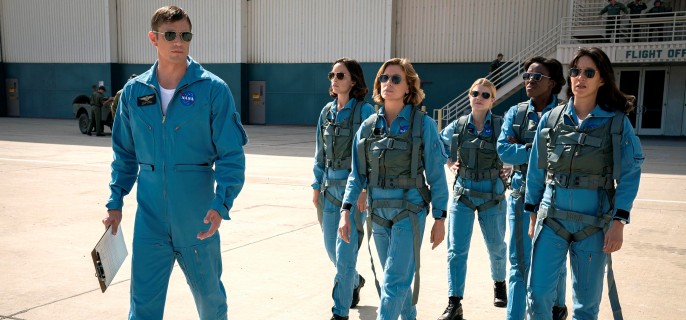
Also, the Apollo 24 crew—Ellen, Deke, and Harrison "Harry" Liu—are finally getting ready for their launch. But lurking in the background of their preparations is the still-present racism and sexism that an acceleration of the space program hasn't managed to completely solve. The jabs made by a TV reporter interviewing the crew, as well as the grumblings from the Apollo 24 backup team (a trio of white men who aren't thrilled about being secondary to "the chick, a geezer, and a Korean") are troubling touches, mostly for what they threaten about the future. But Harry, in his brief introduction, feels like an intriguing new character whose loyalty to his crewmates makes him easy to like.
President Kennedy is also still under fire for his extramarital affair (as the headlines put it, "President seen as compromised morally, politically"). Not as controversial, though, is young Aleida, who has recently gotten herself a boyfriend with the hickies and varsity ring to prove it. However, she's still passionate about her interest in math and science and finds herself torn when, thanks to Margo's help, she gets admitted to an advanced program of study that could ensure her future... but will mean leaving behind her friends to attend a new school.
All of this unfolds as the Russians linger precariously near the American base on the moon, and Ed strives valiantly to spy on them, eventually discovering that they've planted a surveillance device to monitor the American ice-mining operations. The more the Russians infringe upon American activities on the moon, constructing subterranean levels to their own base, the more jittery the Americans become. The situation takes a psychologically brutal turn when Shane's medical condition becomes a global headline, reported around the world but withheld from Ed... until, of course, the Russians manage to send him a text message: "DEEPEST SYMPATHIES ABOUT YOUR SON." NASA tries to maintain Ed's belief that this is all just a part of Russian psychological warfare, but the deception crumbles when Karen's second opinion confirms the initial finding: Shane will not recover. In tears, Karen tells Ed the truth, and Ed, devastated, finds that bottle of Chivas that Gordo had smuggled up to the base weeks ago. No parent should ever have to mourn a child, in an ideal world—but to do so while 238,900 miles away from everyone you know? Unfathomable.
In terms of the season, how Shane's death affects the remaining story is as much a mystery as anything else in store for this show. It's ironic how, after watching enough TV, you start to feel like you can anticipate certain events; certainly For All Mankind hasn't been completely immune to story points feeling like obvious choices. (As just one example: the marriage of Ellen and Larry.) But here we have a very clear example of the show taking a different path where it might have taken a conventional one, and while any narrative centered around a dead child is difficult to process, just what this means going forward is almost impossible to predict. It's a scattered episode, one that isn't afraid to get raw with its emotions but lacks the cohesion of other installments. Only two episodes left in the season; hopefully it all comes together in the end.

